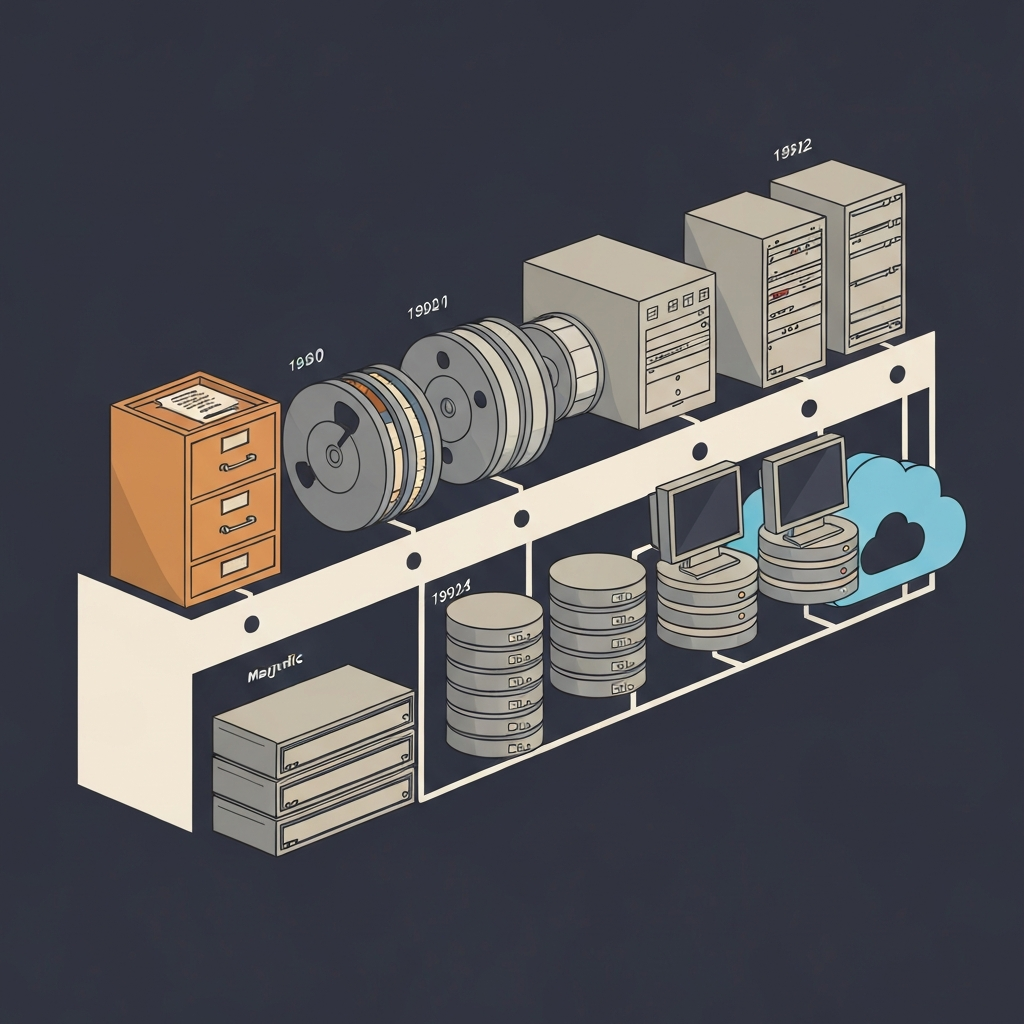
Introduction to Data Storage: The Beginnings of Information Management
Before the digital revolution reshaped the landscape of information management, data storage was an inherently manual process. Filing cabinets and paper systems were the mainstays of data organization in offices worldwide. These systems, while pioneering at the time, were fraught with limitations.
Filing cabinets offered a semblance of order in a chaotic paper-driven world. Each drawer represented a kingdom of information, while folders within drawers provided further categorization. However, this system had its downsides. It was labor-intensive and prone to human error. Misplacing a file could mean hours of searching, and duplicating information required physically photocopying documents, consuming both time and resources.
Limitations and Inefficiencies of Manual Systems
- Space Consumption: Filing cabinets occupied significant physical space, which constrained storage capacity critically dependent on the available infrastructure.
- Access Time: Retrieving information was not instantaneous. It could take minutes, if not hours, to locate and extract a required file.
- Data Integrity: Files were susceptible to wear and tear, and disasters like fires or floods could destroy years of records.
- Collaboration Issues: Simultaneous access to records by multiple users was impossible, limiting teamwork and efficiency.
These drawbacks set the stage for innovation in data storage as the world moved into the twentieth century.
Electronic Data Storage: Ushering in a New Era
The mid-20th century witnessed the introduction of electronic data storage, marking a seismic shift in how data was handled. The introduction of magnetic tapes and disks significantly altered the data storage landscape, offering unprecedented improvements in speed, efficiency, and capacity.
Magnetic tapes were among the first electronic storage devices, designed to replace punch cards. They provided a sequential access method to data, meaning that to retrieve a specific piece of information, one had to go through other data sequentially, which was faster than manual systems but still not optimal.
Later, magnetic disks, with random access capabilities, revolutionized how data could be stored and retrieved. This allowed users to access data directly, considerably improving retrieval times and laying the groundwork for more sophisticated data storage solutions.
The Birth of Database Systems: The 1960s Revolution
The 1960s heralded the birth of the first database management systems (DBMS). A landmark development during this era was IBM's Information Management System (IMS), developed for NASA to track and manage the immense data needed for the Apollo space program.
IMS represented a structured approach to data management, organizing data into hierarchies. This development marked the start of the digital databases offering a method to store, query, and manage data electronically.
IMS and its contemporaries introduced the idea of centralizing data management, conveying transformations from isolated data islands to integrated systems with centralized control able to support a wide array of business functions.
Hierarchical and Network Databases: Early Models
The hierarchical database model employed by systems like IMS organized data in a tree-like structure, where each record had one parent and could have multiple children, similar to a family tree.
In contrast, network databases, typified by systems like CODASYL, allowed more complex relationships through graphs. Each record could have multiple parents and children. This flexibility allowed for more advanced, nuanced relationships, making them suitable for handling complex applications such as airline reservation systems.
Nevertheless, these models had inherent constraints, particularly in terms of flexibility and ease of access, which led to the development of more versatile systems.
The Development of Relational Databases: E.F. Codd's Innovation
In 1970, the landscape of database systems underwent another fundamental shift with E.F. Codd's introduction of the relational database model. Codd proposed that all data should be stored in tables, or "relations," which allowed greater flexibility in how data could be accessed and manipulated.
This model eradicated the rigidity of hierarchical and network databases by enabling flexible querying using Structured Query Language (SQL), forming the basis for nearly all modern database systems. The relational model's ability to handle large volumes of structured data efficiently changed how businesses operated, making data more accessible for decision-making processes.
The Rise of SQL: Standardizing Data Queries
Following the development of relational databases, SQL emerged as a powerful tool for using the relational model effectively. Initially developed as SEQUEL (Structured English Query Language) by IBM, it quickly became the industry standard.
SQL's strength lies in its simplicity and power; it provided a standardized mode of communicating with relational databases. This universal language enabled interchangeability and interoperability among various database systems, fostering data-driven applications' development across different platforms.
SQL remains a critical skill for database professionals today, with an essential role in managing and manipulating vast amounts of data in diverse settings—from corporate databases to user-generated content on social media platforms.
Object-oriented and NoSQL Databases: Handling New Data Challenges
With the Web's growth and the Internet of Things (IoT) emergence, databases faced new challenges presented by unstructured data, leading to the development of object-oriented and NoSQL databases.
Object-oriented databases (OODBMS) support the storage, retrieval, and manipulation of data as objects, facilitating the seamless integration with object-oriented programming languages. They support more complex data types and relationships, making them suitable for applications requiring rich data representations, such as multimedia databases.
NoSQL databases, on the other hand, offer a variety of models, including document-based, key-value, graph, and column-family stores. These systems address needs requiring scalability, high-availability, and flexibility that traditional relational databases sometimes struggle to meet, particularly for real-time web applications, big data analytics, and cloud computing solutions.
Cloud-Based Database Solutions: Revolutionizing Accessibility
The arrival of cloud computing marked another revolution in data management, offering scalable resources and advanced capabilities at reduced costs. Cloud databases enable businesses to focus on utilizing data-driven insights rather than on infrastructure management, leading to enhanced innovation and operational efficiency.
Services like Amazon RDS, Microsoft Azure SQL Database, and Google Cloud SQL have lowered the entry barriers for organizations of all sizes, allowing them to deploy, manage, and scale databases on a global scale without maintaining physical hardware.
Such advances improve accessibility and reliability, supporting dynamic and highly distributed workloads, critical in catering to the now commonplace geographically dispersed applications.
Open-source Database Advancements: Democratizing Database Access
In recent years, open-source databases such as MySQL, PostgreSQL, and MariaDB have seen rapid growth, democratizing access to powerful database technologies. These systems support a broad community of developers collaborating to improve and maintain software, ensuring high reliability and cost-effectiveness.
These open-source systems provide enterprise-level capabilities without the prohibitive costs of proprietary systems, enabling educational institutions, startups, and non-profits to leverage technology typically reserved for larger organizations.
Open-source databases are integral to fostering innovation, breaking down barriers for data experimentation and development.
Globalization and Its Effects on Databases
As our world becomes increasingly digitized and interconnected, globalization continues to influence how databases are structured and managed. For businesses and individuals in the digital economy, there is a growing need to handle multilingual datasets, comply with international regulations, and manage data across time zones and geographic boundaries.
This globalization has affected database technology, necessitating real-time replication, synchronization, and robust data privacy measures. Modern databases must be prepared to handle diverse data formats and support interoperability with multinational informational systems.
Conclusion: Why This Matters for Programming
Understanding the evolution of data storage and databases is crucial for programmers. It highlights the continuous innovation required to keep pace with data demands and the importance of choosing the correct data management solutions for specific applications.
Knowing the history enables developers to appreciate current technologies and anticipate future trends. This section provides the foundational knowledge for deeper exploration in subsequent chapters, setting the stage for more complex architectures and data management strategies.
Common Misconceptions
- Misconception 1: Digital databases completely eliminated paper records upon introduction. In reality, many organizations transitioned gradually, maintaining dual systems for a period.
- Misconception 2: All databases utilize SQL and are relational; however, various models, including NoSQL, cater to different application needs.
This comprehensive look at the history of databases facilitates an appreciation of their impact on present-day programming and sets a platform for further study.